Logo Le Roy tuin, de ecokathedraal van Heerenveen

Ecocathedralen: waar plant, dier en mens samenwerken...
... en waar ruimte de tijd krijgt, en tijd de ruimte
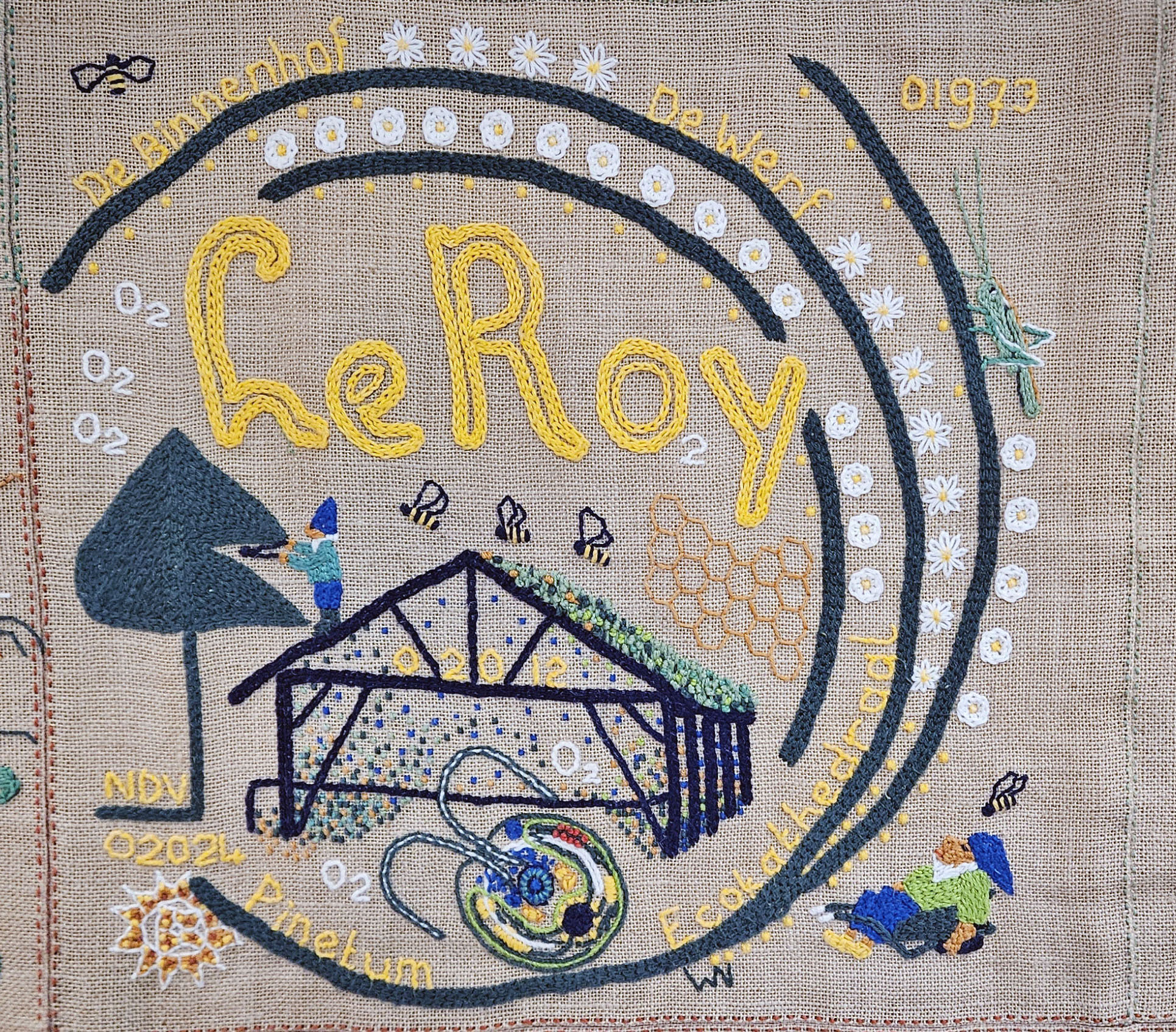
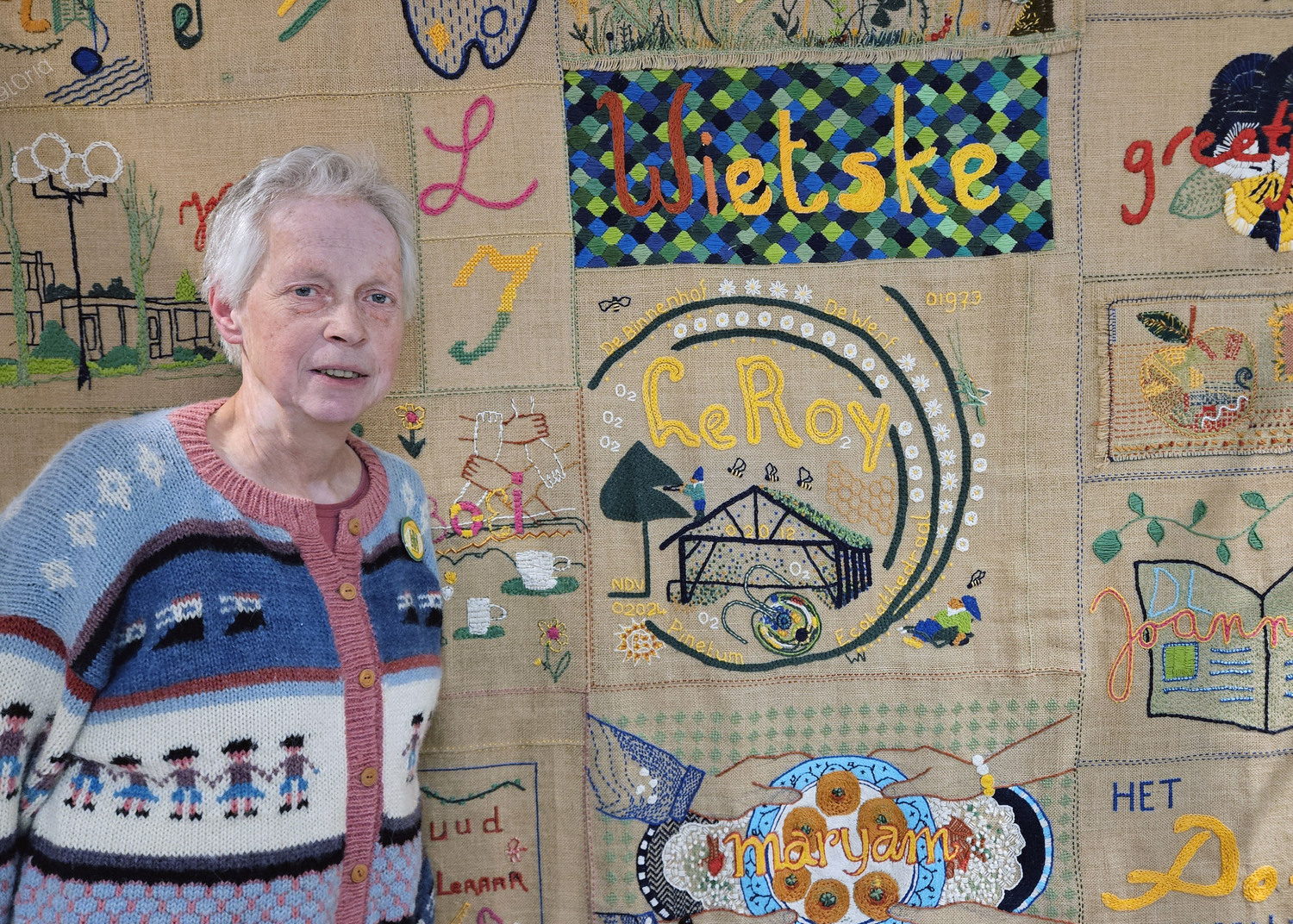
Wini Douma with her Le Roy piece of the tapestry about Lewenborg.

Wini Douma, who has been active for years in the LeRoy area in the Groningen district of Lewenborg, embroidered part of a tapestry about Lewenborg with a reference to Le Roy.

The idea behind the project titled "Name Made in Lewenborg" was to have residents of Lewenborg embroider a section of the tapestry with the name of a person who meant a great deal to Lewenborg. Wini chose Louis Le Roy.

A booklet about the tapestry has also been produced. In it, all participants describe what they have made. Wini writes the following about her contribution:

I started by embroidering the name. And I find the LeRoy House very important. It is nice to discover the LeRoy area in Lewenborg. In the summer you can walk in the shade, and in the winter you are not bothered by the cold east wind. I think the Binnenhof is a very beautiful part of the LeRoy area. As volunteers, we hardly work there because the local residents do that themselves. A number of backyards there blend very beautifully into the LeRoy area.

Years with an extra zero

I have embroidered three years in my work. There is an extra 0 before each year. The idea comes from Louis le Roy. It has to do with the perception of time. After all, the calendar does not stop after the year 9999, which is why I place a 1 before the four digits.
1973 marked the beginning of the LeRoy area in Lewenborg. In 2012, the LeRoy House was built, and 2024 was the year the pinetum was recognized by the Royal Netherlands Dendrological Society. You can find this conifer garden at the intersection of Noorddijkerweg and Stadsweg.

I also embroidered a large green bush cricket. There is a large version of such a cricket at De Werf. In the bottom left, I embroidered a Pediastrum simplex. That is a microalgae found in water that produces oxygen.
At the LeRoy House, I embroidered a chlorophyte cell. Chlorophyte cells are found in everything green, such as algae, leaves, and grass. Photosynthesis takes place in these cells, during which oxygen is also produced.

Gnome

On October 31, 2024, I went to the TIJD symposium in Heerenveen. There, Henriette Le Roy spoke about her childhood and a father who was somewhat annoyed that the daughters were sitting at home. "There is a gnome in the garden." The daughters were still gullible back then and went outside to look for a gnome. I wanted to turn it into a fairy tale with butterflies, frogs, and gnomes, and was completely convinced that I had to embroider gnomes. That gnome in the bottom right is thinking about the future of the LeRoy area and maintaining the nature of the wheelbarrow.

It was in the autumn of 2024, and the De Buitenplaats museum in Eelde had just reopened. It is now an Art Nouveau museum. At home, I have a book by Mucha about Art Nouveau. The idea to embroider round circles with flowers came from that book.
It bothered me that none of the ladies on the embroidery project had chosen Quatrebras, the name of the pinetum. Only after some time did I come up with the idea to embroider the words: Pinetum, De Werf, De Binnenhof, and Ecocathedral along the circles.
 

Microalgae

 
I had a plate with a strong magnification of microalgae that produce oxygen. Quite interesting, actually. That is how the idea of a chlorophyll cell came about. Something you normally don't see, but which is nevertheless a very important aspect of a green area. And so the idea and the space to embroider frogs and butterflies disappeared.

Pinetum

Something from the Pinetum had to be on the canvas, but I had no idea which tree or where on the canvas. And then a message arrived saying that our Pinetum had been officially recognized by the Dutch Dendrological Society. Absolutely a milestone. There was an NDV logo in the app. I thought the logo was perfect for my embroidery.

tapestry le roy lewenborg winni douma Detail of the Lewenborg tapestry in which Wini Douma depicted the LeRoy area.
Want to help out?

Would you like to work as a volunteer on the Heerenveen ecocathedral? You can!
Get in touch , and we'll see what you like and what you can do.
Or come by sometime on a Wednesday morning. We are often working there then.

Agenda

31 Oct 02026;
13:00 - 16:30
TIJD-symposium 02026

The stage is yours!

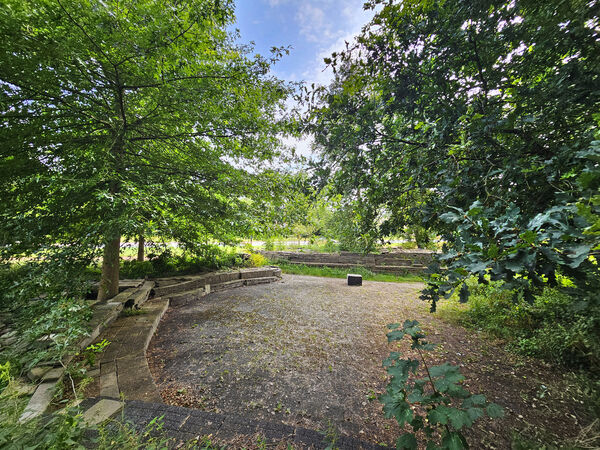
Located in the Le Roy Garden is a small, atmospheric open-air theatre with a capacity of approximately 80 visitors. It is ideal for staging small performances of singing, recitation, music, theatre... Email or call us and inquire about the possibilities.

thumb open-air theater le roy garden

Guided tour or lecture on ecocathedrals?

Would you like a guided tour of the Le Roy Garden, or a lecture on ecocathedrals? Please contact us. You can do so by email or by phone at 06-24573020 .

Donate stones?

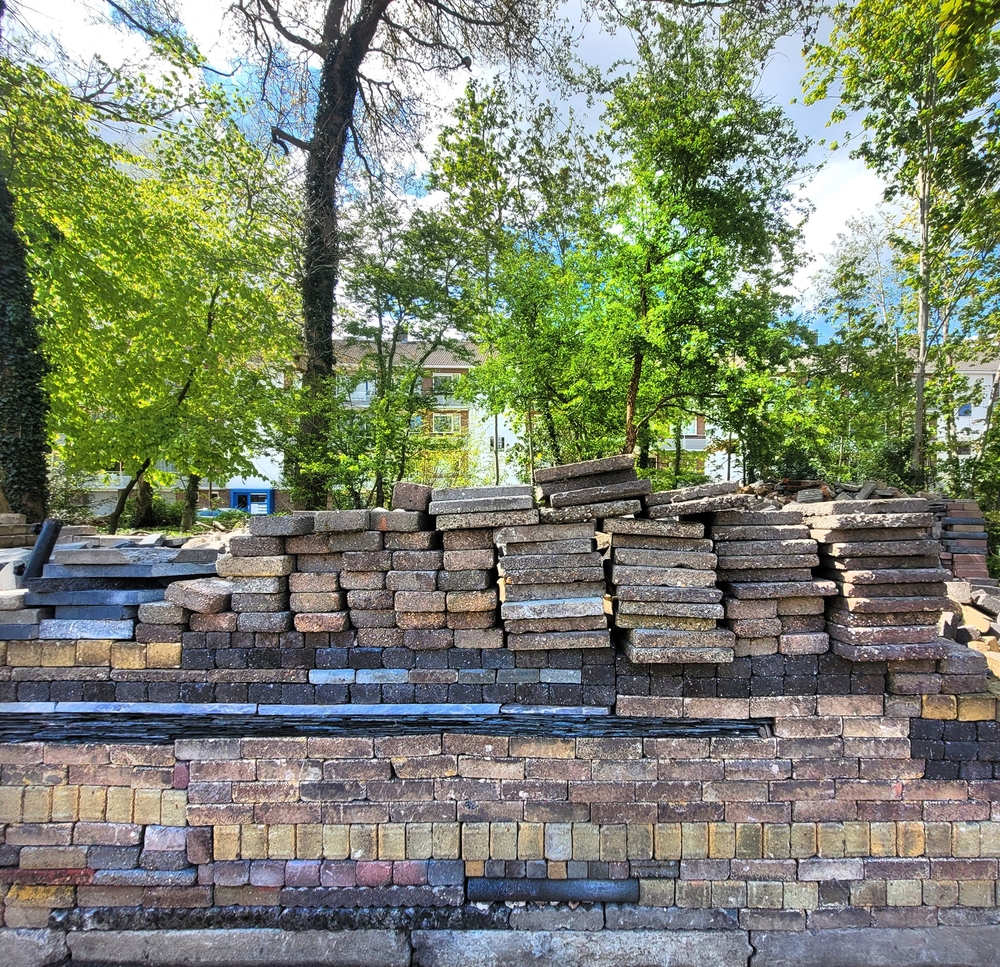
Do you have any stones left over and would you like to donate them to the Le Roy garden? Please contact us first, so you can immediately find out whether (and if so, where) you can bring the stones. Bringing (or collecting) material without prior notice is therefore not permitted.

tiles NK tile removing in ecocathedral Heerenveen


See also:

Other long-term art projects

Various artists have been inspired in one way or another by the long term, also known as cathedral thinking. A number of interesting examples:

  1. The Letters of Utrecht (02000 - as long as there are Saturdays): a poem that is written letter by letter every Saturday in the city center of Utrecht using stones.
  2. The Time Pyramid of Manfred Laber in Wemdinge, Germany
  3. The Future Library (02014 - 02114) of Katie Paterson in Oslo, Denmark.
  4. The Longplayer at Trinity Buoy Wharf in London, a musical piece that lasts 100 years and has been playing since January 1, 2000.
  5. The Tropfenstein machine (01996–02496) with which a stalactite is made in a museum in Hamburg.

" For a proper understanding of what is written, it must always be borne in mind that when nature is mentioned, natural processes are *always* meant, but never nature in its temporary form ." Louis G. Le Roy ( 1924 - 2012 )

" When we build, let us remember that we are building for eternity. Let it not be for present pleasure, nor for present use only; let it be such a work that our descendants will be grateful to us for it ." John Ruskin (1819–1900)